

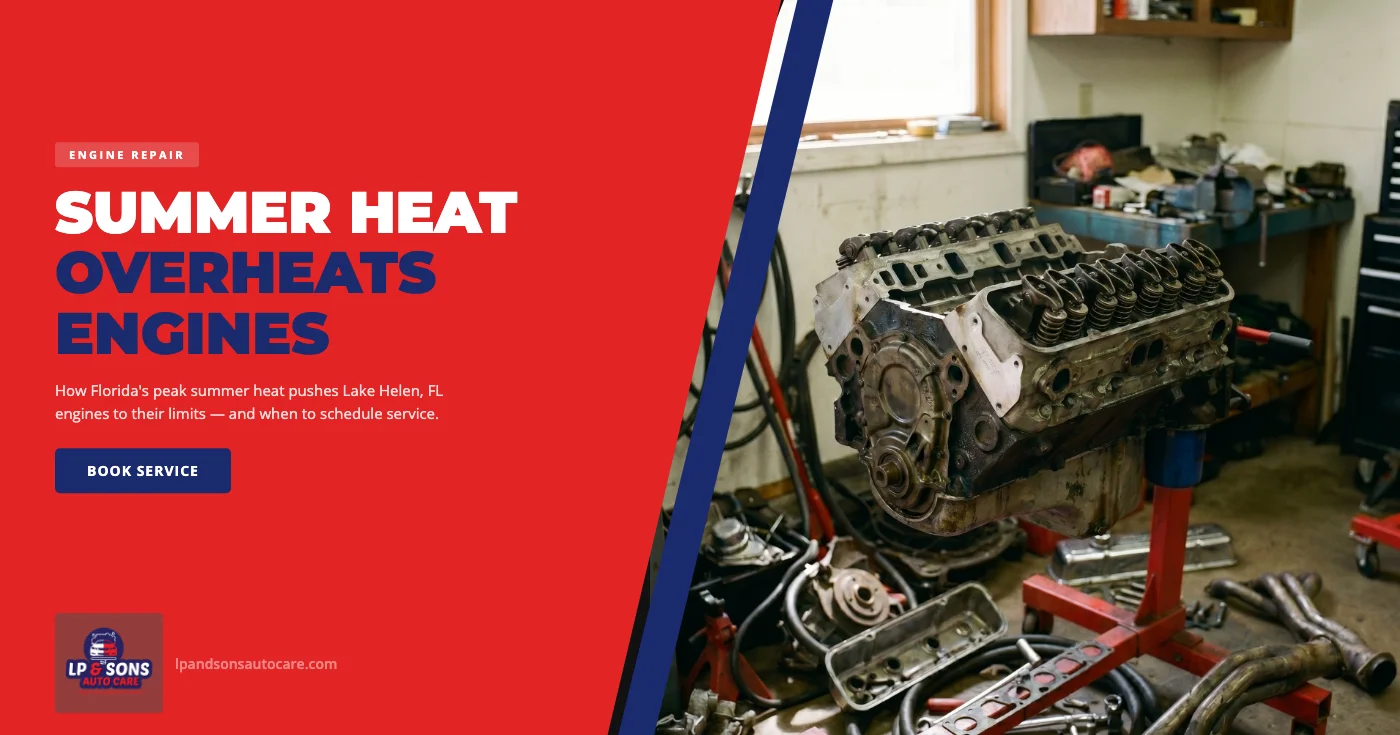
Living in Lake Helen, FL means enjoying small-town charm surrounded by moss-draped oaks — but it also means driving through some of the most punishing conditions your engine will ever face. Florida's peak summer heat pushes cooling systems to their limit, and every year we see Lake Helen, FL vehicles rolling into our shop with overheating problems that were entirely preventable. At LP & Sons Auto Care, we've spent years keeping Central Florida vehicles running through the worst of what Florida throws at them. Here's what every Lake Helen, FL driver needs to understand about engine overheating — why it happens, how to spot it early, and what to do the moment your temperature gauge starts climbing.
Why Florida's Summer Heat Pushes Engines to Overheat
Your engine is designed to run within a narrow temperature range — typically 195 to 220 degrees at the coolant. When ambient air in Lake Helen, FL climbs into the mid-90s and pavement radiates past 130 degrees, your cooling system has to work dramatically harder to shed that heat. In cooler climates, radiators pull heat out of coolant into 60 or 70 degree air. In Lake Helen, FL, that thermal cushion barely exists.
Add in how Lake Helen, FL drivers actually use their vehicles — A/C running full blast, stop-and-go traffic heading to DeLand or Orange City, idling in drive-throughs, short trips that never let the cooling system stabilize — and you have a recipe for accelerated stress. The engine is producing near-peak heat, the A/C compressor is adding load, and airflow through the radiator drops to almost nothing at idle. This is exactly when overheating shows up.
According to AAA's summer heat guidance, extreme temperatures are among the most stressful conditions a modern vehicle encounters, and cooling components degrade faster in these environments than in temperate climates. For Lake Helen, FL drivers, this isn't a seasonal warning — it's the reality from May through October.
How High Temperatures Strain Your Cooling System
The cooling system in your Lake Helen, FL vehicle is an interconnected network — radiator, water pump, thermostat, cooling fans, hoses, and coolant, all working together to move heat away from the engine. When peak summer heat arrives, every one of those components faces more stress than it was designed to handle.
Rubber hoses become more pliable in extreme heat and more prone to swelling, softening, and splitting. Plastic radiator end tanks — standard on most modern vehicles — are more susceptible to cracking under thermal cycling. We routinely find heat-degraded hoses and stress-cracked plastic on Lake Helen, FL vehicles that would have lasted years longer in a milder climate.
The coolant itself breaks down faster in high-heat environments. Modern long-life coolants are engineered for 100,000 miles or more under normal conditions, but "normal" doesn't include Florida summers. In Lake Helen, FL vehicles that see year-round heat, coolant additives deplete sooner, corrosion inhibitors wear out earlier, and heat-transfer capacity drops. An 80,000-mile flush interval in Michigan often looks more like a 60,000-mile interval in Lake Helen, FL.
Warning Signs Your Engine Is Overheating in Lake Helen
Recognizing early warning signs is critical for Lake Helen, FL drivers, because catching the problem before the gauge pegs into the red can be the difference between a routine repair and a catastrophic engine failure. Here are the symptoms every Lake Helen, FL vehicle owner should learn to spot:
- Temperature gauge creeping above normal: If it climbs past the three-quarter mark — especially in traffic or at idle — treat it as a warning.
- Steam or vapor from under the hood: White vapor is often the first visible sign that coolant is boiling.
- Sweet chemical smell: Ethylene glycol coolant has a distinctive sweet odor. If you smell it inside or outside the cabin, coolant is leaking somewhere.
- Coolant puddles under the vehicle: Bright green, orange, or pink fluid pooling under a parked Lake Helen, FL vehicle is almost always coolant.
- Reduced engine power: Some modern vehicles enter "limp mode" when they detect engine temperatures approaching damaging levels.
- Unusual ticking or knocking: An overheating engine can produce these sounds as internal components expand beyond their designed clearances.
- Coolant temperature warning light: A thermometer icon on wavy lines — never ignore it.
Any of these warrants immediate attention. If you spot them, don't push through and hope it resolves — schedule a professional Engine Repair inspection right away.
What to Do the Moment Your Temperature Gauge Spikes
If your temperature gauge climbs into the red while driving through Lake Helen, FL — whether on Providence Boulevard, near downtown Lake Helen, or heading down I-4 — take these steps immediately. Acting quickly can protect your engine from catastrophic damage.
Turn off the A/C and turn the heat on high. This sounds counterintuitive in Lake Helen, FL summer heat, but the cabin heater core acts as a secondary radiator, pulling heat away from the engine. It'll make the cabin miserable for a few minutes, but it can buy critical time to reach a place to pull over.
Reduce load on the engine. Ease off the accelerator, avoid hard acceleration, and drive gently. Coast where you can rather than working the engine.
Pull over as soon as conditions permit. Find a level spot off the road, put the vehicle in park, and shut the engine off. Continuing to drive an overheating Lake Helen, FL vehicle risks warping the cylinder head, blowing the head gasket, or seizing the engine — repairs that can cost thousands.
Do not open the radiator cap. The system is pressurized, and opening a hot cap can result in a burst of scalding coolant and steam. Wait at least 30 minutes after shutdown — and ideally, wait for a professional.
Call for a tow rather than driving to the shop. Even if the engine seems to cool down, driving a Lake Helen, FL vehicle that has already overheated can compound the damage. Get it towed to LP & Sons Auto Care so we can diagnose the underlying cause without added risk.
AAA also recommends carrying emergency supplies — water, a simple first aid kit, and a way to signal for help — for exactly these Lake Helen, FL summer scenarios.
Common Causes: Coolant Leaks, Failing Water Pumps, and Clogged Radiators
When Lake Helen, FL vehicles come into our shop with overheating complaints, we see the same handful of causes over and over. Understanding what's most likely to fail helps Lake Helen, FL drivers make informed decisions about preventive maintenance.
Coolant leaks. The number one cause of overheating in Lake Helen, FL vehicles. A leaking hose, a corroded radiator, a failing water pump seal, a leaking heater core, or even a loose clamp can let coolant escape gradually or suddenly. Florida's heat accelerates the breakdown of the rubber and plastic components that hold coolant in the system.
Failing water pump. The water pump circulates coolant through the engine and radiator. When it fails — worn bearings, a leaking seal, a broken impeller — coolant stops moving effectively. Lake Helen, FL vehicles often see water pump failures earlier than national averages because the pump is constantly working under high thermal load.
Clogged or damaged radiator. Over time, internal passages get restricted by scale, corrosion, and coolant additive breakdown. External damage from road debris, insects, and salt spray (a real issue for Lake Helen, FL vehicles that travel to the coast) also reduces radiator efficiency.
Faulty thermostat. When it sticks closed, coolant can't circulate to the radiator, and overheating happens quickly. When it sticks open, the engine runs cool but efficiency and emissions suffer. Both failure modes are common in Lake Helen, FL vehicles that have been through many thermal cycles.
Broken cooling fans. Electric fans pull air through the radiator when the vehicle isn't moving fast enough for natural airflow. When a fan motor, relay, or sensor fails, the vehicle overheats primarily at idle and low speeds — exactly the conditions Lake Helen, FL drivers face in local traffic.
Blown head gasket. The worst-case scenario — coolant enters the combustion chambers or engine oil, creating white exhaust smoke, milky oil, and rapid overheating. Blown gaskets are often the result of an untreated overheating event, which is why we push Lake Helen, FL customers so hard to address cooling issues early.
Preventive Maintenance to Beat the Florida Heat
The good news for Lake Helen, FL drivers is that most overheating scenarios are preventable with consistent maintenance. Here's the approach we recommend for vehicles operating in our climate:
Coolant inspection and top-off every oil change. Every time your Lake Helen, FL vehicle comes in, we check coolant level, condition, and freeze point. Catching a slow leak or contaminated coolant early prevents downstream problems.
Cooling system flush every 60,000 miles. For Lake Helen, FL vehicles operating in year-round heat, we recommend the more aggressive end of the manufacturer's flush interval. Fresh coolant restores the additive package that protects your radiator, water pump, and heater core.
Hose and belt inspection annually. Coolant hoses degrade from the inside out and often look fine externally right up until they burst. We inspect for softness, swelling, cracking, and pinholes at every visit.
Water pump and thermostat inspection. Both have finite service lives — typically 90,000 to 120,000 miles for water pumps in Lake Helen, FL conditions. Proactive replacement during other cooling service can prevent a roadside breakdown.
Cooling fan operation check. We verify that electric cooling fans engage at the correct temperature thresholds. Given how much Lake Helen, FL driving is low-speed and stop-and-go, fan operation is critical.
Combined with attentive driving habits — monitoring the gauge, avoiding hard acceleration in extreme heat, running the A/C thoughtfully — this preventive approach dramatically reduces the risk of a summer overheating event.
When to Bring Your Vehicle to LP & Sons Auto Care
LP & Sons Auto Care is proud to serve Lake Helen, FL and the surrounding Central Florida communities with expert engine and cooling system service. As master certified technicians working on all makes and models — from domestic pickups to European luxury vehicles — we bring deep experience to every Lake Helen, FL vehicle in our shop.
Bring your Lake Helen, FL vehicle to us whenever you notice any warning sign — a temperature gauge higher than usual, an occasional puff of steam, a sweet smell, a small coolant leak, or a sense that your engine isn't running as cool as it used to. Our diagnostic process combines visual inspection, pressure testing, cooling system component testing, and comprehensive Computer Diagnostics to identify the root cause before it escalates.
We also encourage every Lake Helen, FL customer to schedule a proactive cooling system check-up before the peak of summer arrives — typically in April or May. This lets us catch degraded hoses, weak coolant, marginal thermostats, and other issues before they become roadside emergencies during the hottest months.
For Lake Helen, FL drivers who've recently relocated to Central Florida from a cooler climate, we especially recommend a baseline cooling system inspection. Vehicles that performed reliably up north often reveal weakness in their cooling systems within the first Lake Helen, FL summer — better to know before you find yourself stranded than after.
Every repair at LP & Sons Auto Care is backed by our 3-year / 36,000-mile nationwide warranty, and every Lake Helen, FL customer gets the same attention we've built our reputation on. Contact us today to schedule your cooling system inspection — the peace of mind of knowing your vehicle is ready for whatever the Florida heat throws at it is worth every minute.